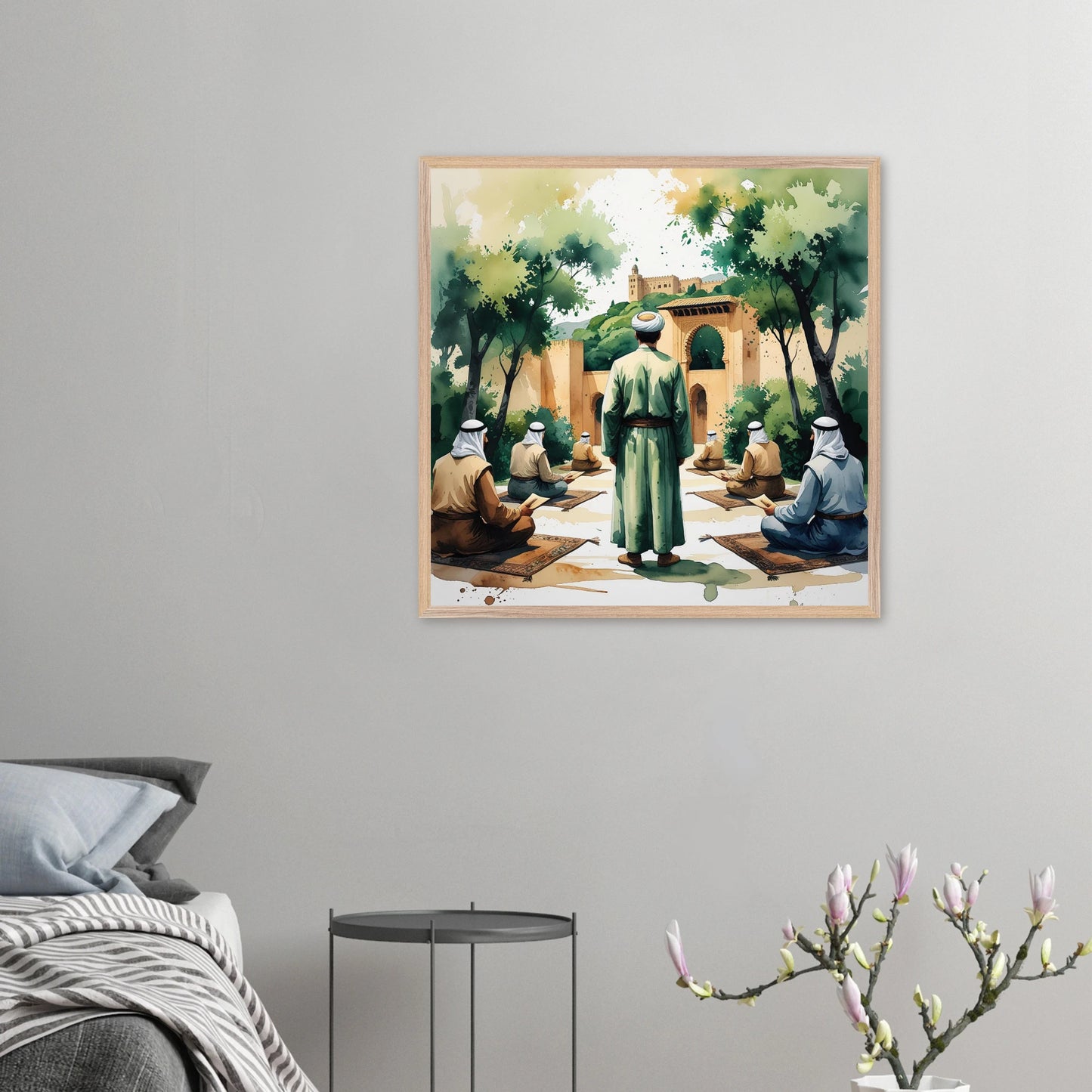
Al-Farabi’s Garden of Philosophy
Couldn't load pickup availability
This artwork presents an interpretative scene inspired by Abū Naṣr al-Fārābī, one of the foundational thinkers of the Islamic Golden Age. A teacher stands before a small gathering of students seated in an open courtyard, surrounded by architectural forms reminiscent of the scholarly environments of medieval Islamic cities. The scene is not a literal reconstruction but an evocation of the intellectual settings in which knowledge was exchanged — quiet outdoor spaces, shaded walkways, and the presence of nature harmonised with built civilisation. It conveys the stillness, discipline, and contemplative energy that characterised classical Islamic learning.
Al-Farabi (d. 950 CE), known as “the Second Teacher” after Aristotle, was one of the greatest philosophers of the medieval world. Working within the vibrant intellectual atmosphere of the Abbasid era, he synthesised Greek philosophical traditions with Islamic intellectual concerns, producing seminal works on logic, ethics, metaphysics, and political theory.
His conception of al-madīnah al-fāḍilah — the “virtuous city” — envisioned a society in which moral excellence, justice, and collective wisdom formed the basis of governance.
His influence extended across centuries: Ibn Sina built upon his metaphysics; Maimonides was shaped by his logical writings; and European scholastics engaged deeply with his ideas through Arabic-Latin translations. Al-Farabi’s works helped define the methodological foundations of Islamic philosophy, anchoring an era in which Baghdad, Bukhara, and Córdoba rivalled the intellectual capitals of the world.
This piece stands as a tribute to the civilisational grandeur of the Islamic intellectual tradition. It reflects a world in which philosophy was a public good, scholarship a communal act, and the pursuit of truth a shared endeavour. Al-Farabi’s legacy reminds us that civilisations are elevated not only through conquests or monuments, but through disciplined thinking, ethical reflection, and the cultivation of human potential.
Displayed in a modern home or study, this artwork becomes a symbol of deep thought, humility before knowledge, and the timeless aspiration for a more virtuous and harmonious society.
Each piece is produced individually on demand, using archival papers and professional inks to ensure exceptional detail, longevity, and a refined finish. This method minimises waste, supports responsible production, and ensures that every print is freshly crafted and inspected to gallery standards before it reaches your home.Every artwork in the Riwayah collection is available in four premium display formats, crafted to suit every home and interior style. Our canvas prints offer a rich, textured finish that brings depth and character to each piece, stretched on FSC-certified wooden bars for a refined gallery feel. For a minimalist and versatile look, our magnetic hangers use durable pine wood to hold your print securely without marking it, making it easy to change artwork whenever you like. Those seeking a classic, museum-style presentation can choose our premium wooden frames, crafted from responsibly sourced oak or ash with visible natural grain and protected with shatterproof plexiglass. And for a sleek, contemporary finish, our aluminium frames pair clean black metal with heavyweight matte paper for a polished, modern aesthetic. All prints use FSC-certified paper and high-quality inks, arrive ready to hang or assemble, and are produced on demand in the UK to reduce waste and ensure the highest standard of craftsmanship.