Harun al-Rashid’s Secret Night Inspections
Couldn't load pickup availability
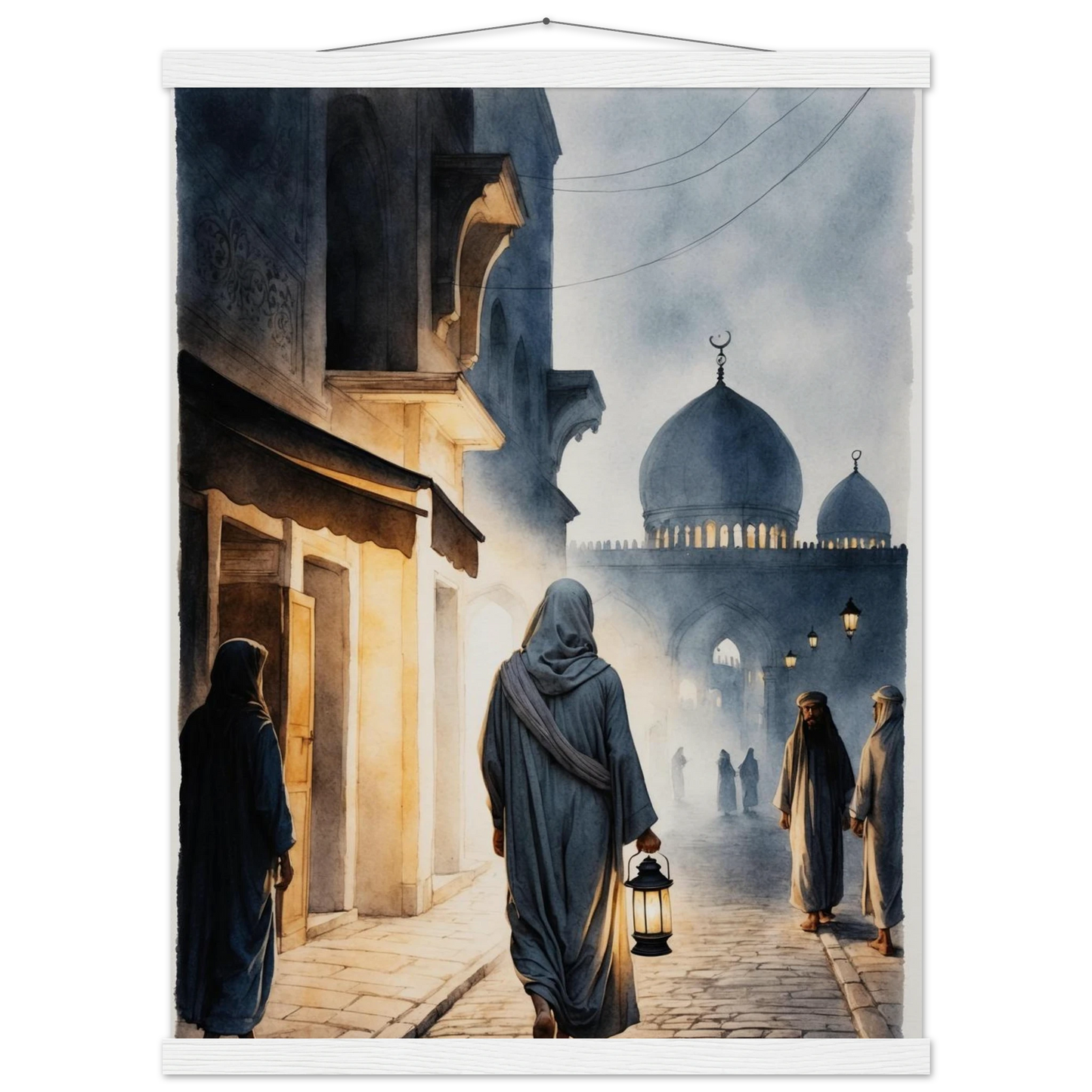
This artwork portrays an intimate moment from the reign of Harun al Rashid, the Abbasid caliph whose nightly inspections of Baghdad became legendary in historical memory. Shown from behind, walking through a dimly lit street, the caliph is depicted as he is described in medieval chronicles: a ruler moving quietly through his capital in disguise, seeking to witness its life without the distortions that come from protocol or hierarchy. The scene reflects a deeper truth about Abbasid political culture, one in which justice was treated as a personal responsibility, and in which a ruler was expected to know the conditions of his people not through filtered reports but through his own direct observation.
Historically, Harun al Rashid ruled an empire stretching from North Africa to Central Asia, presiding over Baghdad at its peak as one of the largest and most dazzling cities in the world. The city hosted scholars, astronomers, poets, jurists, translators, physicians and craftsmen. Its markets and canals filled the air with the hum of a civilisation confident in its knowledge and wealth. Yet the same chronicles that describe this splendour, such as those of al Tabari, al Masudi and Ibn al Jawzi, also recount Harun’s concern that the prosperity of the court could distance him from the needs of ordinary people. To counter this, he began a habit of leaving the palace at night dressed as a commoner, accompanied only by a few trusted companions. Moving through the markets and alleys, he listened to conversations, observed transactions, questioned shopkeepers and residents, and looked for signs of hardship, corruption or neglect.
These night inspections served as a system of real governance. Harun discovered cases of over taxation, abuses by local authorities, or merchants struggling under unfair practices. He intervened directly, replacing officials, issuing decrees or offering support where needed. His presence in the streets forced bureaucrats to behave with greater honesty, for they could never be certain when the caliph himself might appear. This approach to leadership, rooted in accountability and humility, became a model remembered for centuries. In many societies of the same era, rulers lived far removed from public life, shielded by layers of privilege. Baghdad’s caliph, by contrast, sought closeness to those under his rule, believing that a ruler who loses sight of his people cannot judge fairly or govern wisely.
The relevance of this moment continues into the present day. Harun’s secret inspections embody the idea that institutions must be grounded in lived reality, not in abstract reports. His actions remind us that justice requires proximity and that leadership, to be meaningful, must be informed by the voices of those who do not often reach the halls of power. The artwork captures this philosophy through a quiet, contemplative moment: a single figure walking through the night in a vast and complex city, searching for truth where it can be most clearly seen.
Displayed in a contemporary setting, this piece becomes a meditation on responsibility, humility and the moral weight of leadership. It invites reflection on the timeless question of how rulers, institutions or communities can ensure that justice is not distant or theoretical, but grounded in real human experience. Harun al Rashid’s night walks endure as a testament to a civilisation that understood justice as a living practice.
Every artwork in this collection is available in four thoughtfully selected display formats, designed to complement a wide range of interiors while maintaining a consistent standard of quality and finish.
Our framed canvas prints offer a subtle, tactile texture that adds depth and presence to each piece, professionally stretched over FSC certified wooden bars for a clean, gallery-ready presentation. For a lighter and more flexible option, our museum-quality paper posters can be paired with magnetic wooden hangers crafted from smooth pine, allowing the artwork to be displayed or changed with ease while remaining securely held.
For a more traditional presentation, our premium wooden frames are made from responsibly sourced oak or ash, chosen for their natural grain and durability, and finished with shatterproof plexiglass for long-term protection. Those seeking a contemporary look can opt for our aluminium frames, combining slim black metal with heavyweight matte paper for a crisp, understated finish.
All prints are produced using high-quality, archival-grade inks on FSC certified papers. Each piece is made individually to order, helping minimise unnecessary waste while ensuring careful attention to quality and consistency. Your artwork arrives ready to hang or assemble, crafted to be enjoyed for years to come.