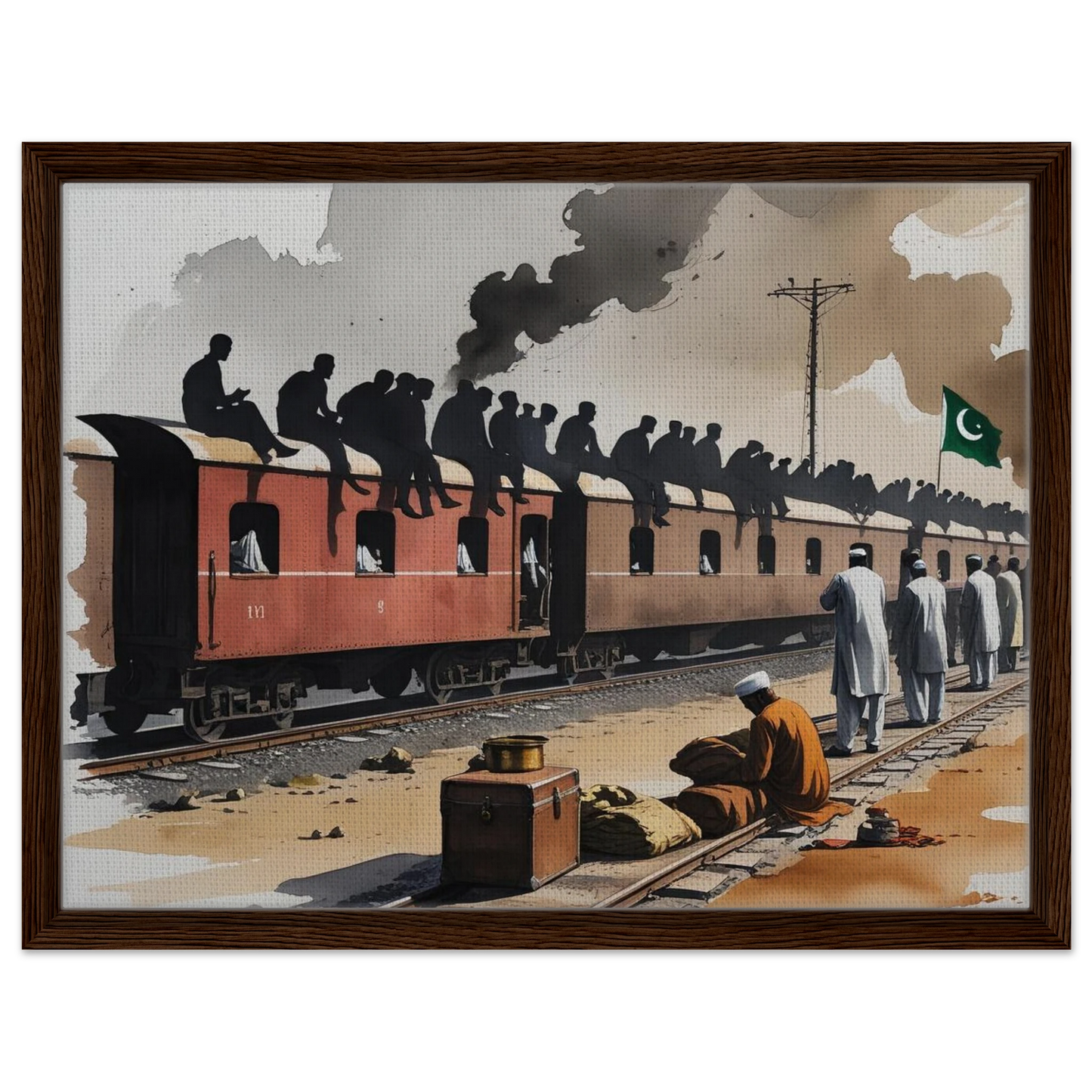
Partition wall art print of a refugee train crossing the newly divided Punjab in 1947, carriages crowded to the roof, moving through a landscape split by a line drawn in five weeks. Painted in soft watercolour with fine ink detail and no facial features, steam and plain dissolving into white space at the edges. A solemn, moving piece for a study, hallway, living room or library.
Cyril Radcliffe arrived in July 1947, drew the borders of two nations in five weeks and left before independence was declared. Fourteen million people then tried to cross those lines, many by train. Some trains arrived with no survivors. Radcliffe burned his papers, refused his fee and never returned.
A meaningful gift for anyone with a family Partition story, or for a historian or teacher of South Asian history. Part of the Riwayah Studio Azadi collection: Partition of India poster, 1947 train art, Pakistani heritage print, Indian heritage wall art, independence history wall decor.
Country of origin: designed in the United Kingdom and printed to order in your own region, so US orders are printed and shipped within the US with no customs charges or import duty. This is an original paper art print.
Printed on premium 200 gsm matte paper with a smooth, uncoated finish that holds deep colour without glare. The paper is FSC certified and archival quality, so the artwork will not yellow over time.
Poster only: the print on its own, rolled and shipped in a protective tube, ready for your own frame or hanger. The most affordable option if you already have framing in mind.
Poster with wooden hanger: a black pine hanger with a matching leather cord. Magnetic strips grip the top and bottom of the print without damaging it, so fitting takes seconds and the print can be swapped or framed later. A good choice for renters or anyone who likes to restyle.
Framed print: a slim black aluminium frame, around 1 cm wide, with a shatterproof acrylic front and hanging kit included. The print and frame arrive together in one box, with simple fitting by hand in a couple of minutes.
Every piece is an original Riwayah Studio design, created in the United Kingdom and printed to order at our production partner's nearest facility. Orders placed in the US are printed in the US, and UK and EU orders are printed in Europe. Free delivery is included.