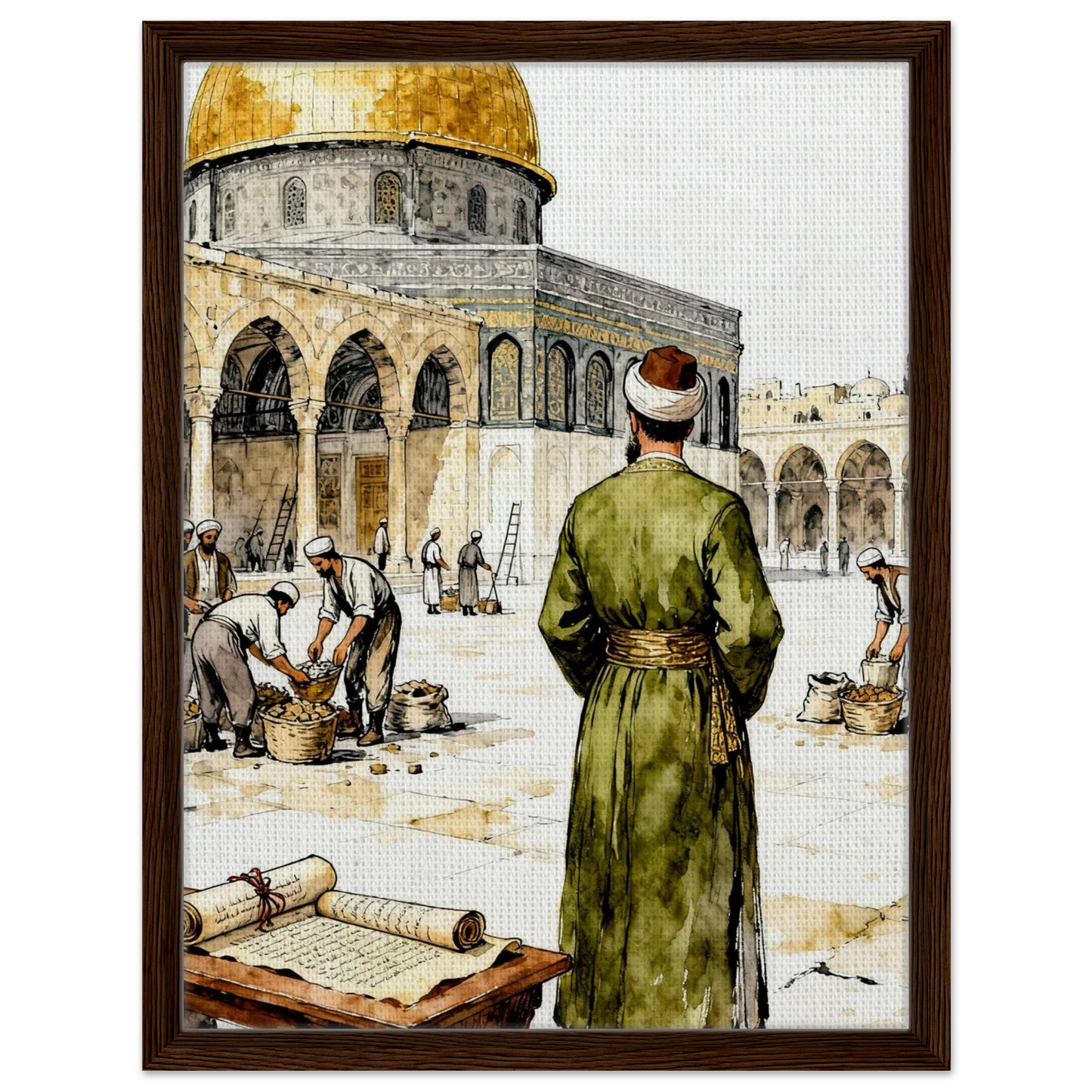
In this artwork, an Ottoman official stands quietly within the sacred precinct of Jerusalem’s Haram al-Sharif, observing craftsmen restoring the stonework of one of the most revered sites in the Islamic world. Before him lies a wooden table holding scrolls and records, symbolising the administrative care behind the preservation of sacred spaces. Rising above the courtyard is the unmistakable golden dome of the Dome of the Rock, its brilliance reflecting centuries of devotion, stewardship, and responsibility.
For hundreds of years, the maintenance of mosques, schools, hospitals, and public infrastructure across the Islamic world relied on a powerful institution known as waqf, or charitable endowment. Through waqf foundations, land, wealth, and property were dedicated permanently for public benefit. These endowments ensured that essential services could continue for generations without relying solely on rulers or state revenues.
During the Ottoman period, which lasted from the early sixteenth century until the First World War, the sacred complex of Al-Aqsa and the surrounding buildings of Jerusalem were carefully maintained through such endowments. Administrators oversaw restoration projects, funded repairs, and ensured that the mosques, courtyards, fountains, and schools within the sanctuary remained active centres of worship and learning.
The figure depicted in the artwork represents the quiet role of these guardians. While rulers and monuments often dominate historical narratives, the preservation of sacred spaces depended on individuals who managed records, supervised repairs, and ensured that endowment funds were used responsibly. The scrolls resting on the table symbolise the legal and financial documents that governed these charitable foundations, reflecting a sophisticated system that protected religious institutions for centuries.
The craftsmen at work in the courtyard illustrate how these endowments translated into real action. Stone by stone, arch by arch, generations of builders and artisans preserved one of the most spiritually significant sites in the Muslim world.
Displaying this artwork honours a tradition of stewardship that safeguarded sacred places through responsibility and community support. It reminds us that the survival of heritage is not accidental. It depends on individuals and institutions who understand that preserving places of worship, knowledge, and culture is a duty carried forward from one generation to the next.
Every artwork in this collection is available in four thoughtfully selected display formats, designed to complement a wide range of interiors while maintaining a consistent standard of quality and finish.
Our framed canvas prints offer a subtle, tactile texture that adds depth and presence to each piece, professionally stretched over FSC certified wooden bars for a clean, gallery-ready presentation. For a lighter and more flexible option, our museum-quality paper posters can be paired with magnetic wooden hangers crafted from smooth pine, allowing the artwork to be displayed or changed with ease while remaining securely held.
For a more traditional presentation, our premium wooden frames are made from responsibly sourced oak or ash, chosen for their natural grain and durability, and finished with shatterproof plexiglass for long-term protection. Those seeking a contemporary look can opt for our aluminium frames, combining slim black metal with heavyweight matte paper for a crisp, understated finish.
All prints are produced using high-quality, archival-grade inks on FSC certified papers. Each piece is made individually to order, helping minimise unnecessary waste while ensuring careful attention to quality and consistency. Your artwork arrives ready to hang or assemble, crafted to be enjoyed for years to come.